

Modern industrial robots are true marvels of engineering. A robot the size of a person can easily carry a load over one hundred pounds and move it very quickly with a repeatability of +/-0.006 inches. Furthermore these robots can do that 24 hours a day for years on end with no failures whatsoever. Though they are reprogrammable, in many applications (particularly those in the auto industry) they are programmed once and then repeat that exact same task for years. A six-axis robot like the yellow one below costs about $60,000. What I find interesting is that deploying the robot costs another $200,000. Thus, the cost of the robot itself is just a fraction of the cost of the total system. The tools the robot uses combined with the cost of programming the robot form the major percentage of the cost. That's why robots in the auto industry are rarely reprogrammed. If they are going to go to the expense of deploying a robot for another task, then they may as well use a new robot. | |||
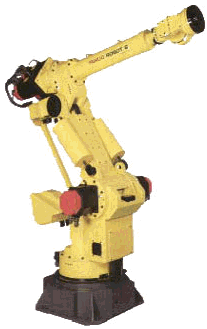 | This is pretty much the typical machine people think of when they think of industrial robots. Fanuc makes this particular robot. Fanuc is the largest maker of these type of robots in the world and they are almost always yellow. This robot has six independent joints, also called six degrees of freedom. The reason for this is that arbitrarily placing a solid body in space requires six parameters; three to specify the location (x, y, z for example) and three to specify the orientation (roll, yaw, pitch for example). If you look closely you will see two cylindrical pistons on the side of the robot. These cylinders contain "anti-gravity" springs that are a big part of the reason robots like these can carry such heavy loads. These springs counter-balance against gravity similar to the way the springs on the garage door make it much easier for a person to lift. You will see robots like these welding, painting and handling materials. | ||
| |||
|
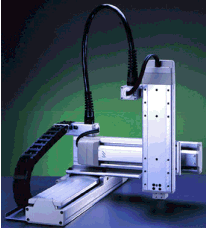
| The machine at left can be called a Cartesian robot, though calling this machine a robot is really stretching the definition of a robot. It is Cartesian because it allows x-y-z positioning. Three linear joints provide the three axes of motion and define the x, y and z planes. This robot is suited for pick and place applications where either there are no orientation requirements or the parts can be pre-oriented before the robot picks them up (such as surface mounted circuit board assembly).. | ||
by
Rich Hooper
learnaboutrobots.com


